
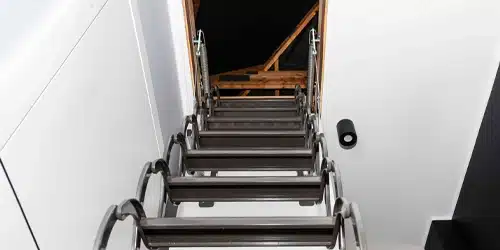
The storage bins are ready, but reaching the attic still means carrying a portable ladder through the house and setting it up under an overhead hatch. Big Foot 24/7 provides attic ladder installation in Oklahoma City for area homeowners who want a more practical route to the opening.
A built-in ladder can reduce the setup involved in reaching an attic, but the right product and placement depend on the home. The opening, ceiling height, floor space, deployment path, and intended use all deserve attention before an installation is planned.
Attic access should work with the room below it. A ladder that cannot open fully, lands too close to a wall, or creates an awkward approach may not solve the problem that prompted the project.
Start with the access need and the available space. Opening size, room layout, and product requirements will determine whether a folding, telescoping, pull-down, or custom access option is worth discussing.
A permanent ladder only provides a route to the attic. It does not establish that the attic floor can support storage or that every area is safe to walk on. Ask an appropriately qualified professional about those separate questions before using the attic for regular access or storage.

Folding attic ladders store in sections above the ceiling and unfold when access is needed. They can be a practical choice where the opening and room provide enough space for the ladder to deploy at its intended angle.
The required floor area matters just as much as the ceiling opening. Doors, walls, parked vehicles, cabinets, and walking paths should be considered so the ladder does not create a new obstacle when open.
Telescoping designs extend and retract in a compact pattern. They may suit spaces where a conventional folding arrangement is not the preferred fit, but product dimensions and operating clearance still control whether a particular model belongs in the opening.
A compact ladder still needs a clear landing area. Follow the model’s operating instructions and load limits.
A pull-down attic ladder gives you a built-in path to the opening without bringing in a separate portable ladder each time. The ladder must still open through a clear path, reach the floor as designed, and close without interference.
The term “pull-down” can describe several configurations, including folding and telescoping products. During planning, focus on the actual mechanism, rough-opening requirements, ceiling-height range, and deployment dimensions rather than the label alone.
Some homes have access conditions that do not match a simple product swap. Big Foot 24/7 can discuss a custom access approach based on the opening, ladder location, ceiling height, and room below.
Big Foot 24/7’s service here is the attic ladder and access installation. Changes to framing, wiring, fixtures, or ducts require the appropriate trade and a separate scope of work.
You may be considering a new access solution because the current opening is hard to reach, the existing ladder is damaged, or a portable ladder takes too much setup. The issue may also be a hatch that is inconveniently placed for the way the room is arranged.
Look at what happens before, during, and after each attic trip. If furniture has to move, the ladder cannot deploy cleanly, or there is no stable approach to the opening, those details should be part of the planning conversation.
Visible looseness, damaged steps, bent hardware, or an access unit that no longer opens and closes normally should not be ignored. Stop using a ladder that appears damaged or unstable and arrange for the condition to be evaluated rather than testing it while carrying a load.
Product fit starts with accurate dimensions. Manufacturers publish rough-opening and floor-to-ceiling height requirements for each model. Match the unit to the space rather than trying to make an unsuitable ladder work.
The surrounding area also needs review. Trim, hatch operation, framing conditions, and the route into the attic can influence whether a product can be installed and used as intended.
Picture the ladder fully open instead of tucked into the ceiling. The feet need an appropriate landing point, and you need enough room to approach and climb without squeezing around a vehicle, door, cabinet, or stored item.
A clear route also helps protect the ladder from impacts when the garage or room is in daily use. Planning around the real layout is more useful than choosing a ladder solely because it fits the ceiling cutout.
Think about how often the attic is accessed and what is normally carried. Occasional seasonal access can create different priorities than frequent entry, but every option should be used within the manufacturer’s stated limits and instructions.
An attic ladder should not be selected as a workaround for moving oversized or excessively heavy items. If belongings cannot be carried while maintaining safe contact and balance, reconsider how those items are stored or moved.
An attic hatch sits between the living space and the attic. ENERGY STAR identifies attic hatches as a common location for air leaks, so pay attention to the hatch as you plan the project.
Big Foot 24/7 installs the attic ladder and access system. For air sealing or insulation, contact a provider that handles that work.
You do not need to choose a ladder model before speaking with Big Foot 24/7. A few basic details will make the first conversation more useful: which room contains the hatch, the approximate ceiling height, and whether an attic ladder is already installed.
Photos can show how close the opening is to walls, doors, cabinets, lights, and parked vehicles. They can also show where a portable ladder currently lands and what makes that setup inconvenient.
Explain how you expect to use the access point and how often you go into the attic. Mention any visible damage to an existing ladder, but do not climb it to take measurements if it feels loose or unstable.
Follow the instructions and labels for the exact ladder installed in your home. FAKRO’s published safety information for attic ladders emphasizes reading the operating instructions, observing labels, and using the product only as intended.
Keep the area below the opening clear before deploying the ladder. Do not use a unit that is damaged, loose, improperly seated, or unable to open fully, and do not exceed the manufacturer’s stated limits.
Climbing while carrying bulky items can reduce your ability to maintain stable contact. Plan attic storage around objects that can be moved safely, and ask for help or another method when an item makes climbing unstable.
Browse our work for project ideas before discussing your opening.
Big Foot 24/7 is based in Mustang and serves Oklahoma City and nearby communities. We handle residential and commercial garage door service and repair, with most of our work focused on homes.

A garage door problem does not always happen during business hours. Our 24/7 emergency availability gives you a way to request help when a door is stuck or an opening cannot be secured.

We work with LiftMaster and Chamberlain openers and Doorlink, Amarr, and Garaga doors. The right choice depends on the opening, compatible components, and how you use the system, not the brand name alone.

Our services include garage floor epoxy, cabinets and closets, and attic ladders and access. You can discuss connected projects while keeping the immediate repair or improvement as the priority.

Tell us what is not working, what you want to change, and where the property is located. Photos taken from a safe position can help explain the situation without requiring you to diagnose the problem or choose a product first.
Explore Big Foot 24/7’s garage services when another part of the space needs attention:

Residential and commercial repair, installation, opener service, and spring service.

Coating projects planned around the existing concrete and intended use.
You do not need to combine services to request help. Start with the problem that matters most, then discuss any related work and the order that makes sense for your garage.
The right fit depends on the opening size, ceiling height, available landing area, deployment clearance, and how you expect to use the access point. Folding, telescoping, and pull-down configurations each have model-specific dimensions, so selection should follow the space and product instructions.
Big Foot 4/7 provides attic ladder installation and access solutions, so an existing unit can be part of the project discussion. The current opening, condition of the surrounding area, new product requirements, and requested removal details need evaluation before the exact scope is confirmed.
Cost depends on the ladder selected, opening and ceiling dimensions, site access, existing-unit removal, and finish details. Big Foot 247 can discuss the next step after learning about the space and the access problem.
Attic ladder installation requires overhead work and must follow the exact manufacturer’s instructions for the product and opening. If you are unsure about fit, support, site conditions, or safe installation, use a professional and do not climb a unit that is damaged or unstable.
For attic ladder installation in Oklahoma City, Mustang, Yukon, Moore, Edmond, Piedmont, Norman, Midwest City, Del City, Blanchard, or El Reno, call Big Foot 247 at (405) 479-5755. You can also use the contact page to share your current access problem, location, and preferred next step.
For attic ladder installation in Oklahoma City, Mustang, Yukon, Moore, Edmond, Piedmont, Norman, Midwest City, Del City, Blanchard, or El Reno, call Big Foot 24/7 at (405) 479-5755. You can also use the contact page to share your current access problem, location, and preferred next step.
Have a question or need a free estimate? Fill out the form below, and our team will get back to you as soon as possible.
