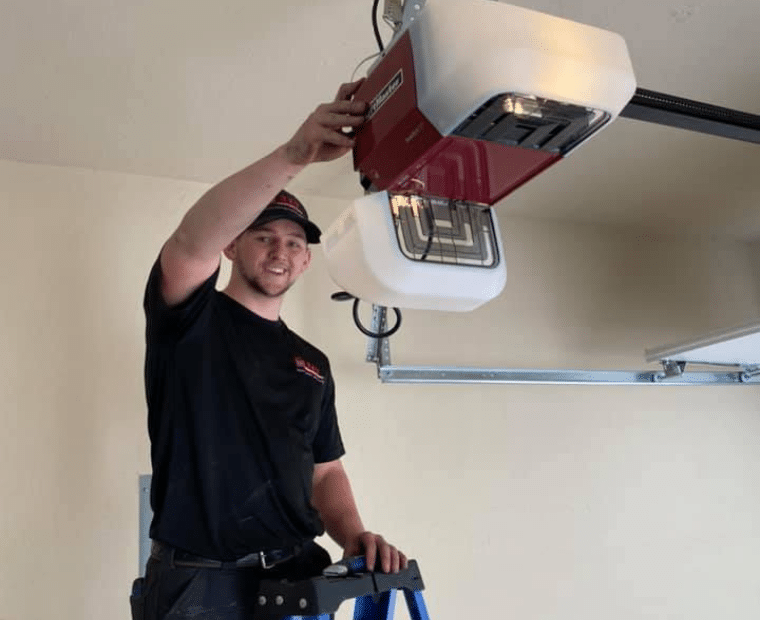
You press the remote on your way to work. The opener hums, but the garage door stays put. The fault may be in the remote, sensor, controls, or operator, although a heavy or crooked door can produce the same frustrating result.
Big Foot 24/7 provides garage door opener repair in Oklahoma City and nearby communities. We check the door and opener together, explain what failed, and compare repair with replacement only after the problem is clear.
An opener problem can trap a vehicle, interrupt access to a business, or leave a door that will not close normally. Big Foot 24/7 offers 24/7 emergency service for urgent situations. Routine problems can be scheduled after you tell us what the door and controls are doing.
Before service, note what happens from each control. Tell us whether the wall control, remote, exterior keypad, or connected app works, and describe any lights, beeps, hums, pauses, or partial movement.
Do not keep cycling a door that strains, jerks, lifts unevenly, or stops with one side higher than the other.
No. Stop using the door.
A broken spring, frayed cable, crooked door, or unexpectedly heavy door is a mechanical hazard, not a remote-control problem.

A motor that runs without moving the door may point to a drive component or a disconnected system. If the opener only hums, stops under load, or works intermittently, repeated button presses will not reveal the fault and may add stress to the system.
Do not open the motor housing or probe powered components. Motor, capacitor, wiring, and logic-board work is not DIY because electric shock, unintended movement, and further equipment damage are possible.
Photoelectric sensors near the bottom of the opening help a door respond to an obstruction. A blocked beam, shifted hardware, or wiring fault can prevent normal closing.
You can look from outside the door’s travel path for an obvious object blocking the opening or a sensor that has been bumped. Do not bypass, tape over, relocate, or defeat a safety device to make the door close.
If the system closes through an obstructed beam, stop automatic use and follow the owner manual for that exact model or arrange qualified service. DASMA directs owners to consult manufacturer instructions, and CPSC guidance says a failed reversal system should be addressed before continued opener use.
If the wall control works but one handheld remote does not, the problem may be limited to the remote, its battery, programming, or compatibility. If every control fails, the cause may be power, lock mode, receiver, wiring, or the opener itself.
Start with observations that do not expose live components. Confirm which controls fail, whether the opener has power, and whether a wall station shows an obvious lock setting described in your owner manual.
A door that stops short or reverses unexpectedly may have a setting, sensor, obstruction, or mechanical issue. The correct response depends on the model and the door’s movement.
Do not increase force to push through resistance or force a safety test to pass. DASMA notes that openers are intended to move properly balanced doors, not overpower doors that feel heavy or bind.
If the door is crooked, unusually heavy, or attached to damaged spring or cable hardware, do not pull the emergency release and attempt a balance test.
No. Stop using the door.
Keep clear and request garage door service.
Intermittent controls, unexplained operation, dead accessories, or repeated error lights can involve low-voltage wiring, the power supply, or the logic board. Testing depends on the exact model and should not start with a cover being removed at home.
Electrical and logic-board work is not DIY. Disconnecting covers, testing energized parts, or replacing circuitry can expose you to shock and can cause unexpected door movement.
Springs counterbalance the door, while cables and other hardware transfer force through the system. A mechanical problem can therefore look like an opener fault.
Warning signs include a loud snap, a visible gap in a spring, loose or frayed cable, a door hanging at an angle, or movement that suddenly feels much heavier.
No. Stop using the door.
Do not touch the spring or cable, do not loosen bottom brackets, and do not try to make the opener pull harder.
Bigfoot 24/7 provides garage door spring repair and broader garage door repair when the fault extends beyond the opener.
Check from a clear position. If you see a broken spring, frayed cable, crooked door, damaged track, or unstable hardware, stop and keep the system out of use.
If no hazard is visible, record which controls work and look for an obvious obstruction without standing under the door. Do not remove a cover or handle exposed wiring.
Use the exact model’s owner manual to interpret lights and user controls. Instructions differ across models, including LiftMaster and Chamberlain products.
For safety-reversal checks, follow the exact owner’s manual on an otherwise normal system or request professional service. If a safety check fails, stop automatic use; do not increase force or bypass a sensor.
Repair often makes sense when the problem is isolated, the part is available, and the rest of the opener and door remain suitable. A failed remote, sensor, accessory, or drive part does not by itself call for a new operator.
Replacement deserves consideration when an essential part is unavailable, several systems have failed, or the operator is a poor match for the door. If safety reversal is not working, take the opener out of automatic use even if it still moves the door.
A new opener will not fix a broken spring, frayed cable, poor door balance, damaged track, or binding sections. Those mechanical issues need correction first, and a larger motor should never be used to conceal them.
If the door itself is at the end of its useful service, Big Foot 24/7 can also discuss garage door installation as a separate decision. Treat the door and opener as separate purchases.
Opener repair cost depends on the diagnosis, model, part availability, controls involved, and whether the fault is actually in the door system. Replacing a remote or sensor is a different job from repairing a drive, motor, or board. Spring and cable trouble moves the call into door repair.
Ask which work restores normal operation and which choices are optional upgrades. New controls or connected access may be useful, but they should not blur the price of the repair you called about.
Big Foot 24/7 is based in Mustang and serves Oklahoma City and nearby communities. We handle residential and commercial garage door service and repair, with most of our work focused on homes.

A garage door problem does not always happen during business hours. Our 24/7 emergency availability gives you a way to request help when a door is stuck or an opening cannot be secured.

We work with LiftMaster and Chamberlain openers and Doorlink, Amarr, and Garaga doors. The right choice depends on the opening, compatible components, and how you use the system, not the brand name alone.

Garage door motor repair, garage door sensor repair, and LiftMaster repair begin with identifying the actual fault. A garage door remote not working can point to the battery, programming, compatibility, receiver, power, or a setting rather than the motor.

Tell us what is not working, what you want to change, and where the property is located. Photos taken from a safe position can help explain the situation without requiring you to diagnose the problem or choose a product first.
Explore Big Foot 24/7’s garage services when another part of the space needs attention:
Residential and commercial repair, installation, opener service, and spring service.

Door replacement planning when the existing sections or configuration no longer fit the property.
You do not need to choose between repair and opener replacement before requesting help. Start with the controls, sounds, lights, and door movement, then let the diagnosis determine which part of the system needs attention.
The cause may involve the drive system, motor, a disconnected mechanism, a binding door, or a door that has become too heavy because of spring trouble. Stop repeated attempts, especially if the door is crooked or heavy, and have the complete system diagnosed.
An obstruction, photo-eye problem, wiring issue, control behavior, travel setting, or mechanical resistance can interrupt closing. Do not bypass the sensors or hold a control to defeat them; use the exact owner manual or arrange service.
No. Logic-board and electrical work is not DIY because shock and unintended door movement are possible, and incorrect testing can damage other components. Keep covers closed and request qualified diagnosis.
A visible spring gap, loud snap, frayed cable, crooked door, or suddenly heavy movement points to a mechanical hazard.
No. Stop using the door.
Do not pull the release or test the balance on an already-failing system.
Price changes with the fault, model, required part, availability, controls, and any related door damage. A diagnosis can separate the necessary repair from optional accessories and show whether repair or replacement is the more practical choice.
If your opener is failing in Oklahoma City, Mustang, Yukon, Moore, Edmond, Piedmont, Norman, or another nearby service area, tell us what each control does and what you see or hear. Big Foot 24/7 can use those details to plan the next step, and you do not need to identify the failed part first.
Call Big Foot 24/7 at (405) 479-5755 or use the contact page to describe the opener model, symptoms, location, and whether the door is currently open or closed.
Have a question or need a free estimate? Fill out the form below, and our team will get back to you as soon as possible.